Cryptographic Application Automation: From Certificates to Real-World Applications
October 19, 2026
Digital certificates and cryptographic technologies are fundamental to establishing trust and protecting digital information. Yet their availability does not automatically translate into widespread, everyday use. Certificates must be obtained and maintained, cryptographic operations must be correctly implemented, and security capabilities must work within the applications people use to communicate, collaborate, and manage documents.
Today, these responsibilities are often divided among different providers, technologies, and application environments. The result is a gap between having cryptographic capabilities and making them work seamlessly in real-world workflows.
1. The Problem: Certificate Authorities and Applications Operate Separately
The digital certificate ecosystem and the applications that rely on certificates have largely evolved as separate systems. Certificate Authorities (CAs) issue certificates after performing the required validation. They establish certificate trust and provide credentials that can be used for cryptographic operations. Meanwhile, email clients, chat systems, document applications, and enterprise business systems implement their own application functions and workflows. Each side performs its own role, but the connection between certificate services and practical application use is often left to users, administrators, or separate integration mechanisms.
Issuing a certificate is only the beginning. Users still need to request or import certificates, install them on appropriate devices, configure applications, manage private keys, and ensure that the right certificates are available when signing, signature validation, encryption, or decryption is required. Certificates must also be renewed or replaced before expiration, and changes must be reflected in the applications that depend on them. When multiple applications or devices are involved, these tasks can become even more complicated.
The same problem extends beyond email. Chat systems and document workflows also need trusted identities and cryptographic protection, yet certificate management and cryptographic operations are not necessarily integrated into their normal application processes. Security capabilities may exist, but using them consistently across different applications can require additional configuration, specialized knowledge, and ongoing maintenance.
This creates a structural barrier to the widespread adoption of cryptography. The burden is not simply the complexity of individual algorithms or certificates, and it is not about the cost of the certificate either. It is the manual coordination required to connect certificate issuance and lifecycle management with the applications that must use those certificates. In effect, users and IT administrators become the operational link between Certificate Authorities and application providers. They must bridge the gap between obtaining trusted credentials and putting those credentials to practical use.
When certificate infrastructure and applications operate independently, people become the integration layer. That is not a scalable foundation for pervasive cryptographic protection.
2. The Solution: Automate Both Certificate Management and Cryptographic Applications
ZTmail brings certificate infrastructure and application-level cryptographic operations together within one Cryptographic Application Automation architecture. The architecture is built on a shared cloud cryptographic infrastructure that connects certificate authorities, certificate lifecycle management, trusted identities, cryptographic operations, and application workflows. Instead of treating certificate management and application security as unrelated tasks, ZTmail automates the connection between them.
Automated Certificate Lifecycle Management
ZTmail automates the certificate lifecycle, covering the processes required to obtain and maintain usable certificates, including requesting, validating, issuing, deploying, renewing, replacing, and revoking certificates.
Automation protocols such as ACME reduce the need for manual intervention in certificate provisioning and renewal. ZTmail applies certificate lifecycle automation to its cryptographic application architecture so that certificates can be managed as part of an operational process rather than as isolated credentials that users must maintain themselves. This capability addresses the first essential requirement: making certificates available and maintaining them throughout their lifecycle.
However, certificate automation alone is not enough. A certificate that has been successfully issued and renewed does not automatically sign a document, encrypt an email, decrypt a received message, or validate a signature. Those operations must also be integrated into the applications that use the certificate.
Automated Certificate-Based Cryptographic Operations
ZTmail extends automation from certificate management to the actual use of certificates in applications. Its cryptographic application capabilities include four essential operations:
- Signing: Apply a digital signature using the appropriate signing certificate and private key with timestamping for document signing.
- Signature validation: Verify a digital signature and evaluate the associated certificate trust and document or message integrity.
- Encryption: Protect information using the appropriate cryptographic mechanisms and recipients' public keys.
- Decryption: Recover protected information using the appropriate private key and integrate the operation into the user's workflow.
These operations are supported by a shared cryptographic foundation, including S/MIME, relevant IETF standards, Chinese cryptographic standards, and algorithms such as RSA, SM2, and post-quantum cryptography as supported by the applicable implementation.
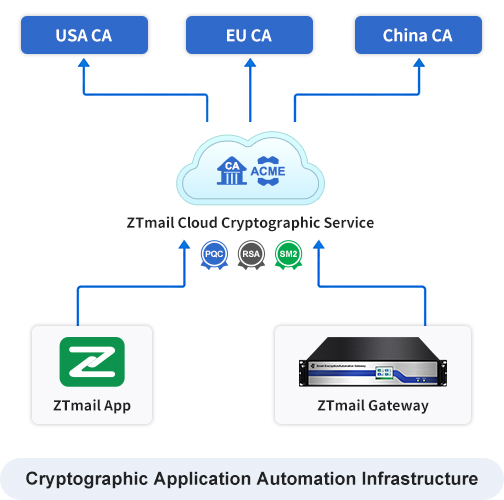
ZTmail also integrates trusted identity, certificate management, key management, and cryptographic policies into the automation process. The objective is not merely to expose cryptographic functions, but to make them usable within the applications and workflows where they are needed. The result is a unified capability layer that connects trusted certificates to practical security operations through Email, Chat, and Document.
3. The Implementation: ZTmail App and ZTmail Gateway
Cryptographic Application Automation must work in different environments. Individuals need security that fits naturally into their everyday applications, while enterprises need consistent controls across organizational users, systems, and business workflows.
ZTmail provides two complementary implementation paths built on the same architectural foundation. One shared cryptographic foundation. Two implementation paths. Three application domains: Email, Chat, and Document.
ZTmail App: Cryptographic Automation for Individuals and SMBs
ZTmail App brings cryptographic application automation to the user endpoint. It integrates certificate management and cryptographic operations into practical workflows, reducing the need for users to handle certificates and keys as separate technical tasks.
For email and chat, ZTmail App integrates S/MIME signing, signature validation, encryption, and decryption into the email workflow, with automated S/MIME certificate management helping reduce the burden of obtaining and maintaining certificates.
For documents, it provides document signing, signature validation, and encryption capabilities with automated document certificate management, including workflows that operate on email attachments and local files. Its cloud signing service further separates the local document from the cloud signing operation, allowing the original document to remain on the user's device while the cloud performs its part of the cryptographic signing process.
ZTmail App is designed to make cryptographic capabilities accessible to individuals and small and medium-sized businesses without requiring them to build and operate their own enterprise cryptographic infrastructure.
ZTmail Gateway: Cryptographic Automation for Enterprise Organizations
ZTmail Gateway brings cryptographic application automation into the enterprise environment. Rather than requiring each user and business system to manage cryptographic operations independently, Gateway provides an organizational implementation path for integrating certificate services, cryptographic operations, and security policies into existing infrastructure.
For email and chat, it supports enterprise integration through SMTP and IMAP proxy architecture, together with email signing, encryption, and decryption capabilities. For document workflows, it provides a path to integrate cryptographic capabilities into organizational business applications.
Gateway also supports centralized policy enforcement and organizational key and certificate management, according to the deployed configuration. This allows enterprises to connect identity and trust requirements with operational security rules and application workflows.
The two implementation paths serve different operational environments, but they share the same underlying architectural objective: make cryptographic capabilities practical, manageable, and consistently integrated into the applications that need them.
4. Why Matters: From Isolated Capabilities to Pervasive Cryptography
The significance of ZTmail's architecture lies in the connection between its components. Certificate Authorities establish certificate trust. Automated certificate lifecycle management makes certificates easier to obtain and maintain. Certificate-based cryptographic operations turn those certificates into usable security capabilities. Trusted identity and cryptographic policies help determine how those capabilities are applied. Finally, ZTmail App and ZTmail Gateway bring them into users' everyday workflows and enterprise systems.
Each component solves a different problem, but their combined value is greater than the sum of the individual functions. Without application integration, certificates can remain unused or difficult to operate. Without lifecycle automation, certificate management can become a recurring source of manual work and operational failure. Without an implementation path suited to the environment, even well-designed cryptographic capabilities may fail to reach the people and systems that need them.
By integrating these capabilities, ZTmail aims to make cryptographic protection a routine part of communication and document handling rather than an exceptional procedure reserved for technically experienced users.
For email, this means making trusted identity, signing, encryption, and decryption part of the normal email workflow. For chat, it means integrating trusted identity and appropriate cryptographic protection into conversations. For documents, it means making digital signing with timestamping, signature validation, and encryption available within document workflows while preserving the distinction between the document itself and the cryptographic operations applied to it.
The same architectural principle applies across all three domains: automate the infrastructure, automate the cryptographic operations, and integrate both into the applications where people work.
5. Certificate Automation Is Necessary. Cryptographic Automation Makes Pervasive Use Possible.
Digital certificates provide a foundation for trust, but certificates alone do not deliver complete application security. Applications can implement signing, validation, encryption, and decryption, but those capabilities are difficult to deploy and sustain when certificate lifecycle management remains a separate manual process.
Automated certificate management is therefore essential. Yet it is only the first step.
Certificates alone are not enough. Applications alone are not enough. Certificate lifecycle automation alone is not enough. Cryptographic operations must also be automated and integrated into real-world application workflows.
This is the role of ZTmail Cryptographic Application Automation architecture. By combining automated certificate lifecycle management, automated certificate-based cryptographic operations, and two complementary implementation paths (ZTmail App and ZTmail Gateway), it provides a shared foundation for bringing cryptographic protection to Email, Chat, and Document.
The ultimate objective is to make cryptography easier to deploy, easier to use, and easier to maintain throughout the lifecycle of digital communications and documents.
ZTmail, One-Stop Cryptographic Application Automation for Email, Chat, and Document.
Click here to read PDF edition (digital signature and timestamp with global trust and global legal effect, all rights reserved, plagiarism is prohibited! Please indicate when reprinting: Reprinted from ZoTrus CEO Blog)