ZT Browser makes post-quantum cryptography visible
December 16, 2025
Please indicate when reprinting: Reprinted from ZoTrus CEO Blog)
Global Internet data is facing a new security threat: "harvest now, decrypt later." Attackers are collecting HTTPS-encrypted data worldwide, hoping to decrypt it when quantum computers become available. The only reliable way to mitigate this threat is for websites to immediately support post-quantum cryptography (PQC) HTTPS encryption, ensuring the security of confidential data both now and in the quantum era.
To enable users to intuitively perceive whether the website they are visiting supports PQC HTTPS encryption, the upgraded version (version 137) of ZT Browser not only supports PQC HTTPS encryption, but also adds a new PQC HTTPS encryption icon (  )to the existing SM2 HTTPS encryption icon(
  )place in the address bar. This allows users to clearly understand whether the website they are visiting uses PQC HTTPS encryption and whether it can protect the long-term security of confidential data. This is a world-exclusive innovation. This article discusses this world-exclusive and ingenious design added to ZT Browser version 137.
1. Seeing is believing, the icon is uniquely designed
To prevent the "harvest now, decrypt later" security threat, PQC HTTPS has become a must for website security. According to Cloudflare statistics, 38% of global Internet traffic already uses post-quantum cryptography encryption. The top 8 of the world's top 10 traffic-heavy websites support PQC HTTPS encryption. Cloudflare is fully implementing PQC HTTPS encryption for the websites it protects. Government websites in the United States, UK, and France, as well as banks and universities in the United States and Europe, have all enabled PQC HTTPS encryption. However, all current articles explaining how to check whether a website supporting PQC require users to use very complex developer tools, which poses a certain technical barrier to entry for ordinary netizens. Making it easy for all Internet users to determine at a glance whether a website supports PQC is an urgent task for popularizing PQC HTTPS encryption.
Anyone who has used the ZT Browser is already familiar with the icon in the address bar. This design has been highly praised by professionals in China cryptography industry and ZT Browser users. They can instantly know whether the website uses the SM2 algorithm to implement HTTPS encryption, and whether it complies with China Cryptography Law and regulations.
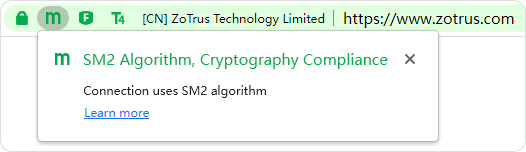
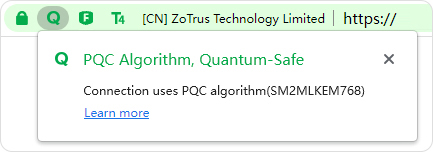
Following this principle, ZT Browser version 137 not only supports PQC HTTPS encryption but also adds a icon in place of the icon, indicating that HTTPS encryption utilizes PQC. Users can confidently visit websites that utilize PQC for data transmission security, ensuring user data is secure not only today but also in the quantum era. If a website supports PQC algorithm HTTPS encryption, a icon will appear after the padlock in the ZT Browser address bar. Clicking the icon will display the following: "PQC Algorithm, Quantum-Safe" and "Connection uses PQC algorithm"
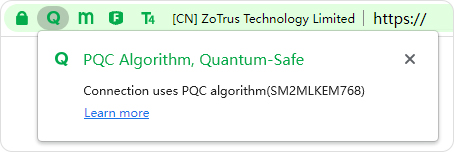
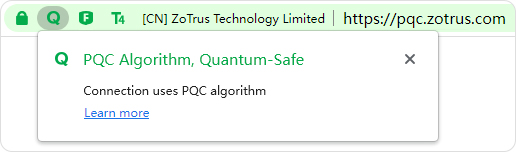
Of the world's top 10 most-trafficked websites, only two don't support PQC. You can use ZT Browser to visit these websites and see if the icon appears in the address bar. Note that ZT Browser also displays the website's trusted identity(  /
/  /
/  /
/  ) and WAF protection
  ) to help users understand more about website security measures.


Of course, there are many websites that have already implemented PQC HTTPS encryption. The author shows 5 more here. You need to use the ZT Browser to discover more websites yourself.





2. ZT Browser prioritizes using TLS 1.3 protocol with support for dual hybrid PQC algorithms
Starting from version V2601, ZT Browser is the first in the world to support the hybrid PQC algorithm with code point 4590 assigned by IANA, combining the SM2 algorithm and the PQC algorithm MLKEM768 - referred to as SM2MLKEM768. ZoTrus HTTPS Automation Gateway also supports this hybrid PQC algorithm. So, when users visit the ZoTrus official website using ZT Browser, the address bar will display both a “” icon and “” icon next to the padlock icon, indicating that the website has completed post-quantum cryptography migration and commercial cryptography compliance transformation. This represents the best solution for China’s commercial cryptography compliance and post-quantum cryptography migration.
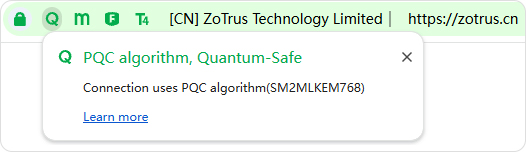
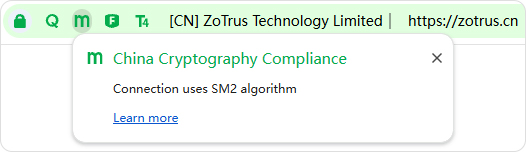
If a website only supports key exchange using the SM2MLKEM768 algorithm, then ZT Browser will only display the “” icon and will not show the “” icon. Only if the website supports key exchange using the SM2MLKEM768 algorithm, server signature using SM2 algorithm, and cipher using SM4 algorithm will ZT Browser display both the “” and “” icons. Of course, if the website supports key exchange using the X25519MLKEM768 algorithm, ZT Browser will also display the “Q” icon.
3. Work together to make the icon more popular and visible
Currently, the world is vigorously promoting the use of PQC hybrid protocols for HTTPS encryption. This is the only effective technical means to prevent the data security threat of "harvest now, decrypt later." Implementing PQC HTTPS encryption, of course, requires browser support. However, this advanced encryption technology is invisible to Internet users, making them completely unaware of it, which is not conducive to the popularization and application of PQC.
ZT Browser is the first browser in the world to exclusively display the PQC icon in the address bar, allowing website visitors to easily understand whether the website they are visiting supports PQC and whether the website can effectively protect the continued security of user data in the quantum era. This is very important for the popularization of PQC applications. Welcome users around the world to work together to promote the popularization and adoption of this innovative UI in all browsers. Only in this way can we truly promote the rapid popularization and application of PQC and truly ensure the continued security of global Internet data.
Let us work together to popularize the use of ZT Browser that supports post-quantum cryptography algorithms and the post-quantum cryptography icon, jointly promote the popularization and application of post-quantum cryptography, effectively safeguard global Internet data security, and keep the icon on the browser address bar.